
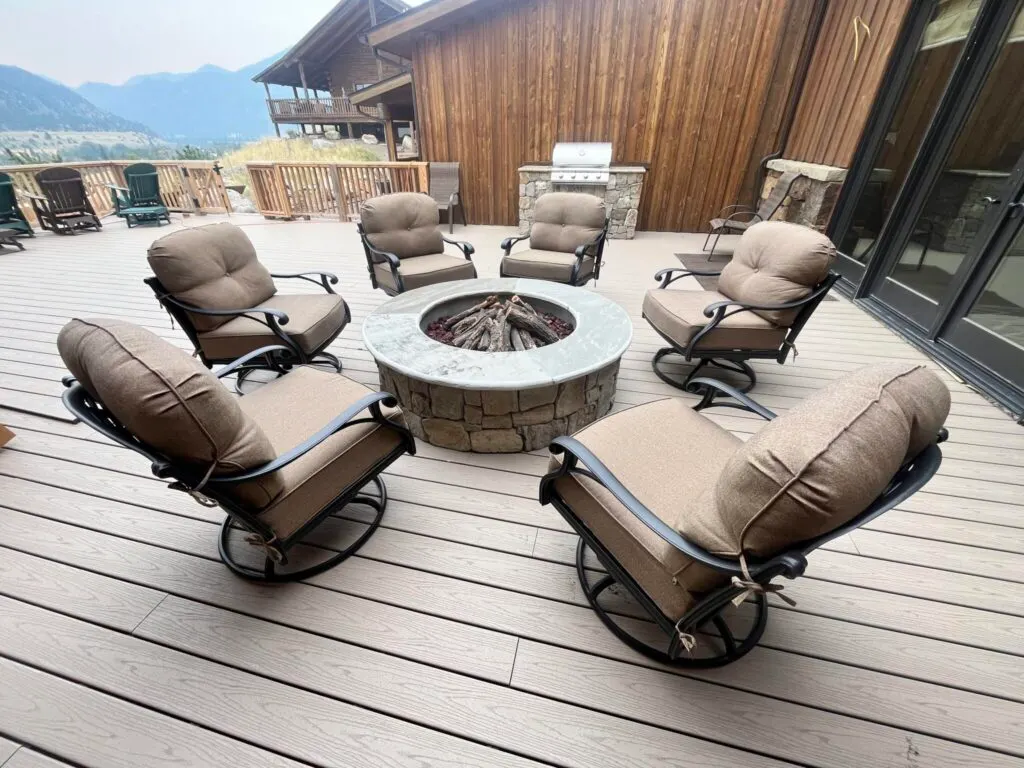
Stone is heavy, and heavy things end up wherever the ground underneath them allows.
Stone Masonry in Paradise Valley, Montana
EZ Road Repair builds mortared and dry-stacked stonework across Emigrant, Livingston, Pray, Chico, and Gardiner — patios and walkways, fire pits, steps, retaining and boulder walls, entrance pillars, and stone veneer on homes and outbuildings. What separates masonry that holds up here from masonry that comes apart in a handful of winters is almost never the stonework itself. It is the footing, the base, and where the water goes. We do that dirt work ourselves with our own excavation equipment, so the ground under the stone gets built to the same standard as the face you look at.
When this matters
- A patio or walkway has heaved, tipped, or opened up joints after a few winters
- A mortared wall is flaking at the joints, or has a crack running up through it
- You want a fire pit or outdoor fireplace that will take repeated heat without breaking down
- Ranch entrance pillars, mailbox columns, or stone steps are leaning or settling on one side
- A new home or remodel calls for stone veneer on a foundation, chimney, or entry
- A slope needs a wall that holds ground and still looks like it belongs to the place
The ground decides, then the stone
Mortared masonry is rigid. It has no way to absorb movement — when the ground under it lifts, the wall does not flex, it cracks, and it cracks along the weakest line, which is the mortar joint. That is why every mortared element we build starts with a footing bearing below frost depth on undisturbed soil or on compacted structural fill, not on topsoil and not on loose spoil from somebody else’s dig. Frost depth is not one number across this valley either; it shifts with elevation, aspect, soil, and snow cover.
Dry-stacked stone works on the opposite principle. Individual stones can shift a fraction without anything reading as failure, which is why dry-stacked and boulder work suit rustic settings and frost-prone ground so well. It still wants a compacted base and drainage — it simply forgives a little movement where mortar will not. Choosing between the two is a judgment about load, setting, and how much movement the site will hand you, not only a question of looks.
Water is the other half of it. Mortar is porous. Joints absorb water, and water that freezes inside a joint expands and pushes the face of the mortar off in flakes — the spalling you see on old chimneys and neglected garden walls. The fixes are unglamorous: tool the joints so they shed water instead of holding it, slope cap stones so runoff leaves the wall rather than soaking into its core, and give any wall retaining soil a clean drain rock backfill with a real outlet instead of the native clay that came out of the hole. Freeze-thaw works every joint on the property, every year.
Where this goes wrong
- Stone set straight on dirt. A patio bedded on topsoil or a loose sand layer holds water, pumps under freeze-thaw, and comes up uneven. Clean angular base rock, compacted in lifts, is most of the difference.
- A mortared wall with nowhere for water to go. Saturated backfill freezes and lenses against the back of the wall, and that pressure finds the joints.
- Caps set dead flat. Water sits on the top course, wicks into the core of the wall, and freezes there.
- Fire pits built out of the wrong stone. Rounded river rock and other moisture-holding stone can crack or pop when heated. A fire pit wants a fire-rated liner with room to expand, not raw fieldstone tight against the flame.
- Veneer with no support and no way to drain. Stone veneer weighs what it weighs — it bears on a ledge or footing and ties back to the wall. Stuck on with adhesive over a wall that cannot drain and dry behind it, it comes off in sheets.
- Mortaring too late in the year. Mortar needs temperature to cure. Late-season work has to be protected or pushed to spring, and the season here is short enough that timing belongs in the design conversation.
How we approach it
We walk the site first and look at slope, soil, access, and where runoff already goes. Then the ground work: strip organics, excavate footings to bearing below frost, and build the base up in compacted lifts. Drainage gets built in at that stage — drain rock, a way out for the water, and finish grade that carries runoff away from the new work instead of into it. Only then does stone start going down. For flagstone patios and walkways we set on a prepared base, keep joints tight and consistent, and hold the surface to a slight fall so it sheds water. Retaining walls and boulder walls get built with batter leaning into the slope, backfilled and drained as the wall rises. Veneer, pillars, steps, and fire pits get laid out and dry-fit before anything is set, so the pattern and joint lines read the way they should. Boulders, flagstone, and base rock come in on our own trucks as delivered materials, and we finish by tying the new work back into the surrounding landscaping. If you have plans from an architect or landscape designer, we build to them; if you have a rough idea and a spot, we will help shape it.
Serving Paradise Valley & Southwestern Montana
Based in Emigrant, we build stonework throughout Paradise Valley — Livingston, Pray, Chico, Gardiner, Springdale — and take larger projects out toward the Bozeman area.
Get a stone masonry estimate
Call (406) 623-9075 or request a quote. Tell us what you want built and where it sits on the property, and we will walk the site and put together a straight estimate.
EZ Road Repair and Excavation — locally owned, Montana tough.