
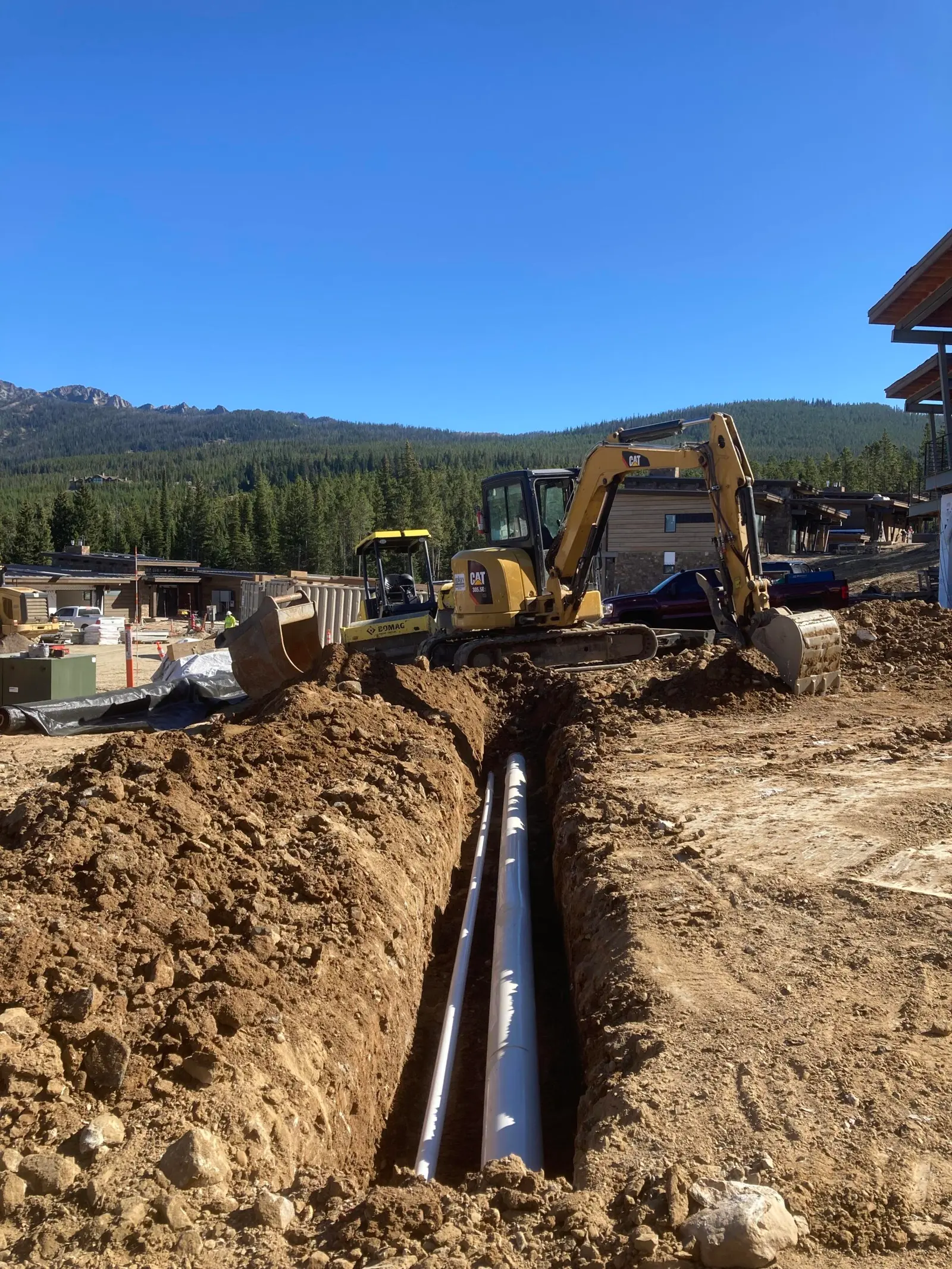
Water is what breaks things out here. Give it a path and most of the damage stops.
Drainage Solutions in Paradise Valley, Montana
Between snowmelt off the Absarokas, spring runoff, and summer downpours, water here is always hunting a way across or through. It finds the low spot, the wheel rut, the backfill against your foundation. EZ Road Repair builds practical drainage for homes, ranches, and rural properties across Emigrant, Livingston, Pray, Chico, Gardiner, and the rest of Paradise Valley. Each tool below has its own page, but the thinking comes first: where water starts, where it wants to go, what it does on the way.
When this matters
- Standing water or soggy ground that won’t dry out in the yard, pasture, or driveway
- A driveway or road that ruts, washes, or turns to soup every thaw
- Water running toward the house, shop, or foundation instead of away
- Spring runoff off the hill crossing your property somewhere new each year
- A culvert or ditch that’s plugged, crushed, silted in, undersized, or was never there
- Ice sheets in the same spot every winter, or gullies cutting a slope or road shoulder
How water actually moves on Paradise Valley ground
Two problems look identical from the porch and need opposite fixes.
Surface water is sheet flow — rain and snowmelt running across the ground — and it responds to shape. Given a route to daylight that runs downhill the whole way, grade alone usually solves it: a crowned road, a swale, a ditch. Subsurface water moves through gravel and cobble underground, often riding on a tighter clay or till layer a few feet down, and surfaces where that layer does. You can’t regrade your way out of that one; it takes a collector drain.
Timing makes both worse. In a Montana spring the top foot of ground thaws while the soil below stays frozen solid. Meltwater can’t percolate — the frozen layer acts like a lid — so it runs on top of ground that would swallow it in August. That’s why a yard draining fine all summer turns into a bog in April, and why we size for runoff, not an average rain.
Ground changes fast here, too. The benches near Emigrant and Pray sit on alluvial fan cobble that digs hard and drains fast; the drainages toward Gardiner and Tom Miner Basin run flashy, arriving all at once with debris.
What goes wrong when drainage is done badly
- No outlet. A drain or ditch that doesn’t run continuously downhill to somewhere water can leave is a bathtub. It’s gravity, no exceptions.
- Culvert at the wrong elevation. Inlet too high and water ponds behind the road. Pipe too flat and it silts in, freezes into a plug, and the next flow goes over the road and takes the fill with it.
- The wrong rock in a French drain. Pit run full of fines, or drain rock with no filter fabric, silts up in a couple of seasons and quits.
- Ditch grade out of range. Too steep it scours into a gully, too flat it silts in. Roughly 1 to 2 percent is the window for an unarmored ditch; past that it needs armor.
- No crown on the road. A flat gravel surface holds water in the wheel tracks until the base turns to pudding. Roughly a 2 to 4 percent crown sheds it first.
- Concentrating flow onto someone else. Runoff that used to spread across a hundred feet, fired out of a pipe at a fence line, just moves the problem downhill. We look at the outlet as hard as the inlet and armor it where velocity demands — see erosion control.
Drainage and the freeze-thaw season
Winter is when drainage problems are made, not just revealed. Water sitting in a ditch in November is ice by January, so spring flow arrives to find the channel already full. Water that soaks into a road base freezes, expands, lifts the surface, and leaves a soft, broken spot behind when it lets go. That’s why we tie drainage into nearly every road maintenance job — keeping water out of a base beats rebuilding one. Late summer and fall are the best windows to do it.
How we approach it
We walk the whole water path first — uphill of the problem, through it, and downhill to wherever it discharges. Then we build the simplest system that solves it:
- Shape the ground. Grading and leveling is the cheapest drainage there is: re-establish a crown, break up a flat spot, set positive fall away from the building — commonly about six inches of drop in the first ten feet.
- Give it a channel. Ditches and swales intercept runoff above whatever you’re protecting and carry it to daylight at a grade that neither scours nor silts.
- Get it under, not over. Culverts at road and driveway crossings, sized for real snowmelt, set at the right invert with adequate cover and armored ends so debris can’t plug them.
- Collect what’s underground. French drains, footing drains, and dry wells for seeps and water pressing on a foundation — perforated pipe in washed rock, wrapped in fabric, on continuous fall to daylight.
- Backfill it right. Excavation for trenching and bedding, backfilled and compacted in lifts so the trench doesn’t settle into a new low spot two years on.
For the whole picture on rural property, see our Montana rural property drainage guide.
Serving Paradise Valley & Southwestern Montana
Based in Emigrant, we handle drainage throughout Paradise Valley — Livingston, Pray, Gardiner, Chico — and the surrounding ranch and riverfront properties. Steep ground needs volume and armor; the mid-valley benches need grade and interception.
Get a drainage estimate
Call (406) 623-9075 or request a quote. Tell us where the water shows up, when it’s worst, and what it’s threatening — a photo of it running beats any description.
EZ Road Repair and Excavation — locally owned, Montana tough.