
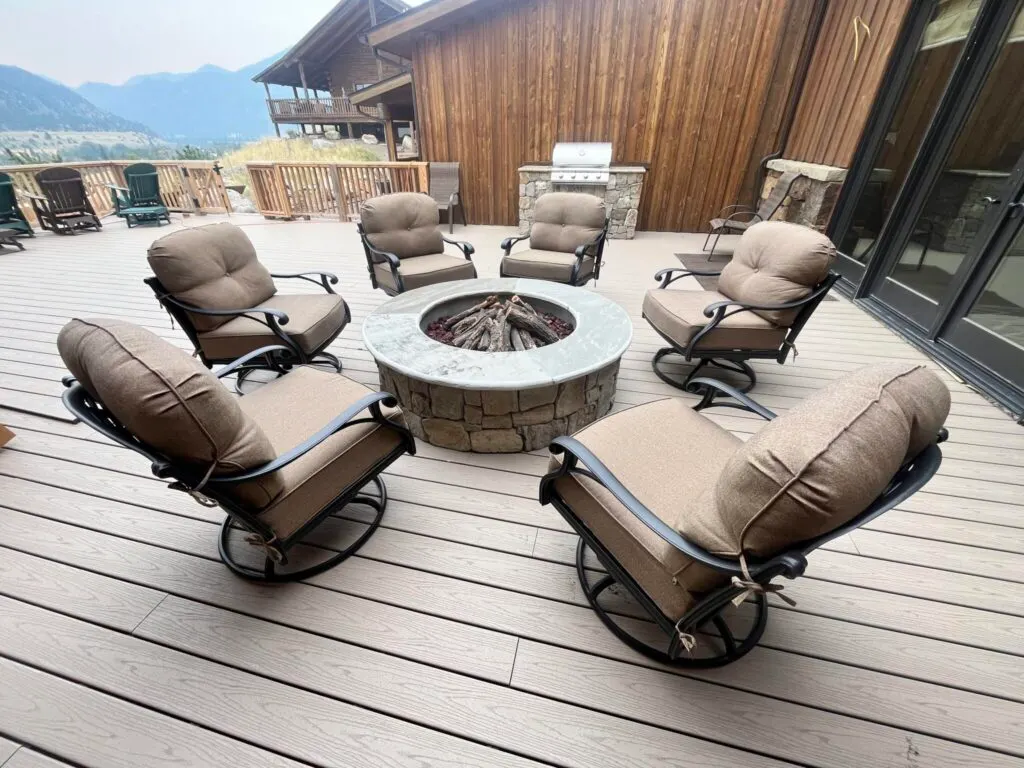
Natural stone, set on a base built for a valley that freezes every year.
Flagstone Installation in Paradise Valley, Montana
Flagstone belongs out here. Laid well, it looks like it grew where you put it. EZ Road Repair sets flagstone patios, walkways, steps, fire pit surrounds, and borders around Emigrant, Livingston, Pray, Chico, and Gardiner, and we do the excavation and base work ourselves. That matters more than the stone selection does: nearly every failed flagstone surface we get called to look at is good stone on a base never built for this climate.
When this matters
- You want a real seating area, BBQ space, or hot tub surround instead of a strip of lawn
- The path from the drive to the door is mud in April and ice in January
- A patio laid a few years back has gone wavy and some stones rock underfoot
- The ground drops away from the house, so the space needs steps or a wall before it needs stone
- Roof or driveway runoff crosses right where you want to walk
Dry-set or mortared
Dry-set means the stone rides on a compacted aggregate base over a thin screeded setting bed, with joints filled by sand, stone dust, or soil and low plantings. Nothing is bonded. The surface flexes with seasonal movement, water drains through the joints instead of standing on top, and a stone that cracks or settles gets lifted, re-bedded, and put back without touching its neighbors.
Mortared flagstone is bonded over a rigid slab. It gives a formal, locked surface with clean joints and nothing growing between the stones, but no tolerance for ground movement — mortar does not flex, so whatever the slab does, the joints do. A mortared patio is only as good as the concrete under it, and that concrete only as good as its base and drainage. Over a thin pour on native soil it cracks in a line straight across, and that repair is never one stone.
Dry-set is the workhorse here. We build mortared surfaces where the design calls for it and the base can carry it.
What actually holds a flagstone patio up
Frost heave needs three ingredients: freezing temperatures, frost-susceptible soil with fine content, and water. Nobody is changing the first, so the job is the other two — getting fines out from under the stone and water away from it.
That starts with excavation. Topsoil and organics come out completely; they compress, they break down, and they were never structural. We dig to firm subgrade — on the valley floor that can mean cutting through clay, on the benches it means hitting glacial cobble that drains beautifully. Where the soil calls for it, a geotextile separation fabric keeps clay from working up into the aggregate over the years.
Then the base gets built, not dumped. Crushed aggregate goes in lifts of roughly three to four inches, each compacted before the next — commonly six to eight inches total for a walkway or patio, deeper where the ground is soft or wet or a vehicle can reach it. Base depth is the number quietly cut to save money, and the one that decides whether the surface is flat in five years. Over it goes a setting bed screeded to about an inch — not a deep sand cushion that lets stones rock.
Grade is designed in from the first cut. A patio is pitched away from the house at roughly a quarter inch per foot, about two percent — enough that water leaves on its own, not enough to feel under a table. A base sitting in a bowl or tight against a wall needs an outlet, daylighted to lower ground or tied into the site drainage. Base rock that holds water is base rock that lifts.
Where this goes wrong
- Stone laid on soil, or on a bag of sand. The most common failure by a wide margin. Looks perfect in September, rocking by May.
- A four-inch base called a six-inch base. Nobody can see the base once the stone is down, which is exactly why it gets shorted.
- Base compacted once, at the end. Eight inches dumped and rolled one time keeps consolidating for years.
- Flat, or pitched back toward the house. Water with nowhere to go stands, freezes, and lifts — pitched wrong, it runs at the foundation.
- Sand piled up to level an uneven stone. Sand migrates. Work the stone, not the cushion.
- No edge restraint. Without a border stone, curb, wall, or compacted shoulder, the outside course creeps out and the field loosens behind it.
How we approach it
We walk the space first and read where water comes from and goes, because that shapes the layout as much as the view does. From there the sequence is consistent: strip organics and excavate to firm subgrade, fabric where the soil needs it, aggregate base built and compacted in lifts, drainage set before anything covers it, then the stone laid out dry before a piece is set — matching thickness, working shapes and joint lines, cutting where a cut reads better than a gap. Grade changes get steps, a boulder feature, or a proper retaining wall rather than a slope people have to be careful on, and larger areas usually need grading around them so the patio sits in the yard instead of perched in it. Joints are filled to suit the style and swept in. The work ties into whatever else is on site — stone masonry, or pavers where a uniform surface fits better; our write-up on hardscaping that survives Montana winters covers that tradeoff.
Serving Paradise Valley & Southwestern Montana
Based in Emigrant, we set flagstone throughout Paradise Valley — Livingston, Pray, Chico, Gardiner — and the ranch and foothill properties past the pavement.
Get a flagstone estimate
Call (406) 623-9075 or request a quote. Tell us the space you have in mind and what happens there when it rains, and we will walk it with you and put together a straight estimate.
EZ Road Repair and Excavation — locally owned, Montana tough.