
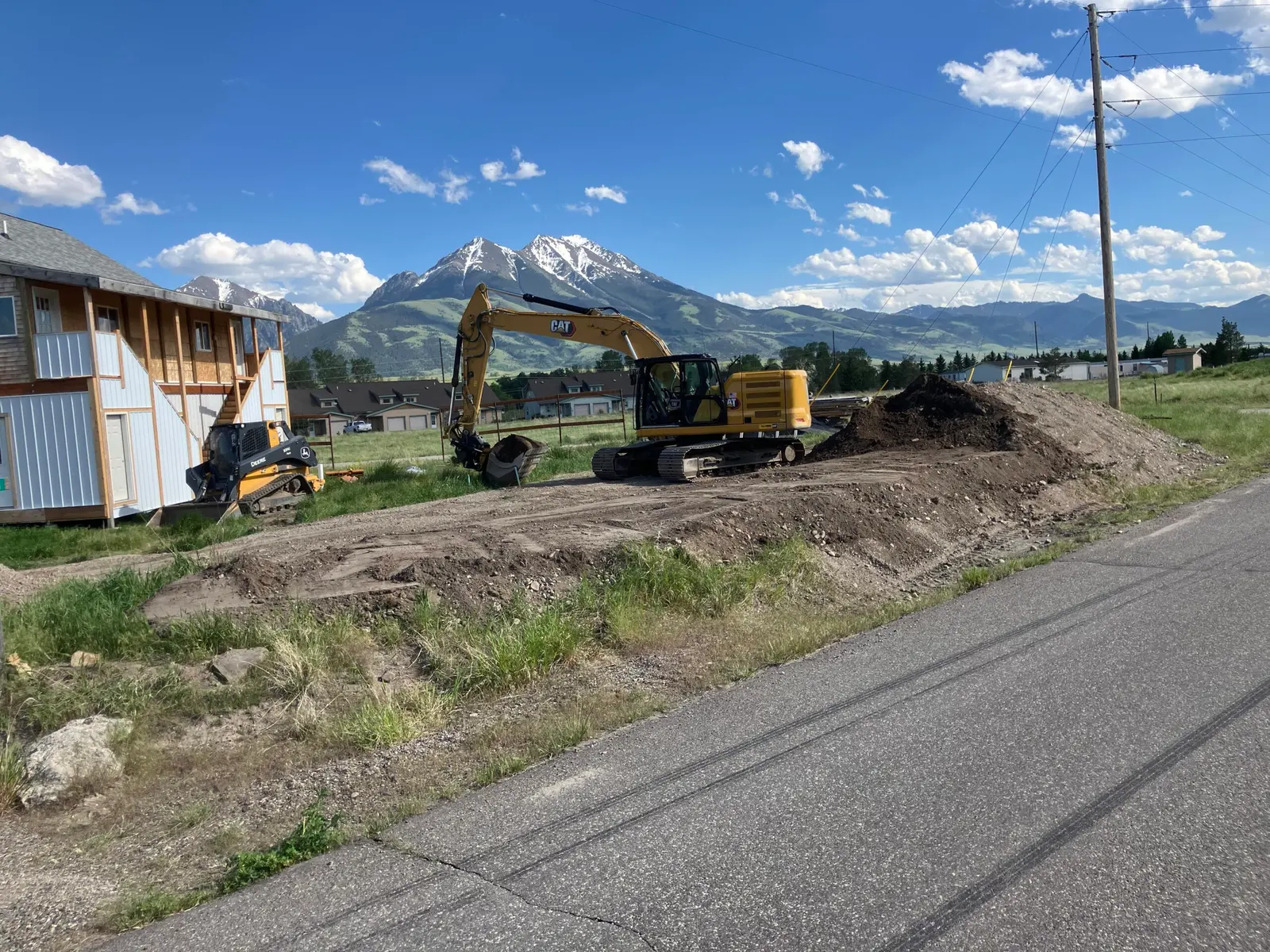
Built to shed water, packed to hold, and shaped to stay that way.
Road Mix & Gravel Driveways in Paradise Valley, Montana
For most rural Montana driveways and ranch roads, a well-built road-mix surface is the practical choice — if it’s built to handle water and freeze-thaw. EZ Road Repair builds and resurfaces gravel driveways across Emigrant, Livingston, Pray, Gardiner, Chico, and the rest of Paradise Valley. Out here a driveway isn’t just where you park — it’s the route the propane truck, the fire department, and the plow use in March, when the frost is coming out of the ground and the surface is at its weakest. Base, crown, and drainage decide whether it holds up.
When this matters
- A new build that needs access from the county road to the house pad
- A two-track that goes soft every spring and dries into washboard every summer
- A ranch or field road carrying loaded trucks, goosenecks, and equipment
- Gravel that keeps disappearing — you add loads every year and never gain a surface
- A sloped driveway that cuts ruts down the wheel tracks every time it rains hard
- A washed-out approach where it meets the county road
Road mix, clean gravel, and pit run
People say “gravel” and mean three materials that do three different jobs. Mixing them up is why a lot of driveways never firm up.
Road mix — often 3/4“ minus or 1-1/2“ minus — is a graded blend of stone, sand, and fines. The fines fill the voids between the stone, and rolled at the right moisture it knits into a dense, hard surface that sheds water. This is your driving surface.
Clean or washed gravel has the fines screened out. It drains freely, which is what you want behind a wall or around a perforated pipe — and exactly what you don’t want on a driveway. With nothing to bind it, it stays loose, rolls under tires, and migrates to the low spots.
Pit run is unprocessed material straight from the pit: mixed sizes, sometimes with cobble in it. It’s economical fill over soft ground, but it’s a base, not a finish. Left on top it gives you a rough surface that’s hard on tires and impossible to plow clean. Longer read: road mix vs crushed gravel vs pit run.
Depth, lifts, and compaction
Thickness is set by what’s underneath, not by a number off the internet. The firm, gravelly subgrade common on the benches needs far less build-up than the clay and silt pockets in the river bottoms and old irrigated ground. The sequence matters more than the total depth:
- Strip the organics. Topsoil, sod, and roots have to come off. Building on black dirt gives you a soft driveway no matter what goes on top.
- Proof-roll the subgrade and dig out the spots that pump or deflect under a loaded truck.
- Separate soft ground. Over wet or clay subgrade, geotextile fabric keeps base rock from sinking into the mud. That’s the answer to “where does my gravel go every year” — with no separation, it migrates down out of sight.
- Build in lifts, not one dump. Material compacts properly in roughly 4-6 inch lifts. Thicker than that and the roller densifies the top while a soft layer stays underneath, waiting to rut.
- Compact at the right moisture. Bone-dry road mix won’t bind no matter how many passes you make; saturated material just pumps. The window is narrow, and hitting it is most of the job — see why compaction makes or breaks a driveway.
Crown and drainage — where gravel driveways actually fail
Nearly every failed driveway we’re called to failed for one reason: water sat on it, or ran down it.
A driveway needs a crown — a high center falling roughly 2-4% to each edge, on the order of a quarter to a half inch of fall per foot. That’s enough for water to leave the surface in a few feet instead of standing. Too flat and it ponds, saturates the base, and the next loaded truck pumps the fines out and starts a pothole. Too much crown and you get a slick hump in winter and gravel working to the edges.
Crown alone isn’t enough on grade. On a slope, water on the surface picks up speed and cuts a channel straight down the wheel track. That’s what water bars, rolling dips, and an uphill ditch at a modest grade — 1-2% moves water without eroding the ditch itself — are for: they shed runoff repeatedly instead of letting it gather for three hundred feet and then dig.
Freeze-thaw finishes the job. Water trapped in a base freezes and heaves the surface, then thaws from the top down in spring while the ground below is still frozen, so the melt has nowhere to go. That’s mud season — and it’s why drainage, not more gravel, is usually the real fix.
How we approach it
We walk the site first and work out where water comes from and where it has to end up. Then: strip and shape the subgrade, excavate the soft spots, build a compacted base sized to your soil, set culverts at the approach and any draw the driveway crosses, cut drainage on the uphill side, then lay and roll the road-mix surface with a proper crown and final grade. Still deciding on a surface? Compare driveway construction options. Building longer than a driveway? See road building and ranch roads. Doing it yourself? We haul road mix, gravel, and fill across the valley — and we can keep an existing surface up under road maintenance.
Serving Paradise Valley & Southwestern Montana
Based in Emigrant, we build and resurface gravel driveways and ranch roads throughout Paradise Valley — Livingston, Pray, Gardiner, Chico — and the surrounding ranch and mountain properties.
Get a gravel driveway estimate
Call (406) 623-9075 or request a quote. Tell us how long the driveway is, what drives on it, and where it gets muddy or washes, and we’ll give you a straight estimate.
EZ Road Repair and Excavation — locally owned, Montana tough.