
A paver surface is only as good as the several inches you can’t see.
Paver Installation in Paradise Valley, Montana
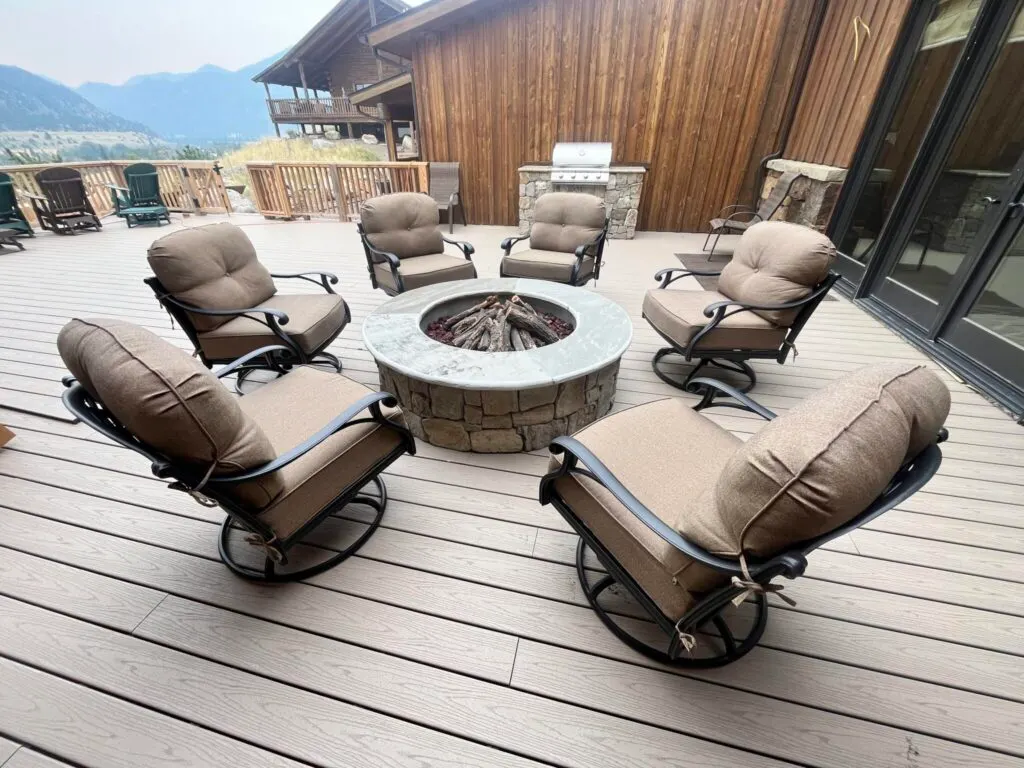
Pavers earn their keep in this climate. The jointed surface flexes through freeze-thaw instead of cracking, and any spot that settles can be lifted and relaid instead of sawn out and patched. EZ Road Repair installs paver patios, walkways, driveways, aprons, and ranch paths across Emigrant, Livingston, Pray, Chico, Gardiner, and the length of Paradise Valley — including permeable systems, where soaking water into the ground beats routing it elsewhere. What decides whether a field stays tight for decades or drifts apart in three seasons isn’t the stone you pick. It’s the excavation, the compacted base, the edge restraint, and the joints.
When this matters
- You want a patio, fire pit area, or outdoor kitchen floor that stays level season after season
- The walk from the driveway to the front door heaves every spring and rocks underfoot
- An existing paver field has gone wavy, dropped at one end, or opened up joints
- Water stands on the patio instead of running off, and the low spot glazes over all winter
- You need firm, mud-free footing around a barn, shop, or shed where equipment turns
- A slab cracked and you’d rather have a surface that moves with the ground
What actually holds a paver field together
Four layers, each with a job.
The subgrade is native ground, cut to depth and compacted. If it’s clay that turns greasy when wet — common on the valley floor — geotextile fabric between subgrade and base keeps the two from mixing, so the base doesn’t disappear into the mud over a few wet springs.
The base is crushed aggregate placed and compacted in lifts of a few inches at a time, never in one deep pass, because a plate compactor only densifies so far down. Foot-traffic patios and walkways generally want on the order of four to six inches of compacted base; anything carrying vehicles wants roughly eight to twelve, more where the soil is soft. The base also has to run past the edge of the pavers — that’s what the edge restraint spikes into.
The bedding layer is about an inch of coarse sand or chips, screeded flat and left alone. It is a setting bed, not a leveling course. Using it to smooth over a base that isn’t right is the most common shortcut in the trade, and it shows up two winters later as waves.
The joints are what make a few thousand loose stones behave as one interlocked field. Sand swept into tight joints and compacted in transfers load from each paver to its neighbors. Ring the perimeter with edge restraint and the field can’t creep outward — the failure that quietly starts every other one.
Where this goes wrong
- Not enough base for the load. A patio-depth base under a driveway apron fails the first time a loaded truck turns on it. Base depth is set by what the surface carries, not by what’s easy to dig.
- Compacted in one lift. Deep fill dumped and hit once from the top passes the eye test, then consolidates for years.
- Sand used to level. Thick bedding sand hiding a rough base migrates under traffic and settles unevenly. An inch, screeded, and no more.
- Edge restraint pinned into soil instead of base. Without a locked perimeter the outer courses spread, joints open, sand washes out, and the movement works inward.
- Set dead flat. A paver surface needs fall — on the order of one to two percent, away from the house — or meltwater sits on it and refreezes.
- Water routed under the field. A downspout or slope feeding the base saturates it, and saturated base heaves. Grade and drainage get solved before the pavers go down.
- Empty joints left empty. Joint sand lost to runoff, plowing, or a pressure washer needs topping up. Bare joints let the interlock go and weeds in.
Pavers through a Montana winter
Freeze-thaw is exactly why pavers work here, but the surface still has to be treated like a jointed one. When you plow or shovel, keep the cutting edge slightly off the pavers, or run a rubber or poly edge; a steel blade dropped hard catches a lip and chips or drags stones out of line. Skid shoes set a touch high do the same thing. For traction, sand and cinders are easier on stone and joints than heavy salt, and they’re what we spread during residential snow removal anyway. Come spring, top up the joint sand the melt carried out. That’s most of the maintenance a paver field asks for.
How we approach it
We walk the site first and look at where water goes now, then set finish elevations against door thresholds, existing grade, and whatever the surface has to drain toward. From there the sequence is the same: excavate to depth with the same crew that does our excavation work, fabric where the soil calls for it, base built and compacted in lifts, bedding screeded, pavers laid to the pattern, edge restraint set into the base, joint sand swept and compacted in. Where a grade change is what makes the space usable, we tie in retaining walls or boulder walls. Where the site sheds water toward the new surface, the french drain or swale goes in at the same time, not retrofitted around finished work. Prefer a natural look? Flagstone is the same base work under a different surface, and both sit under our stone masonry roof.
Serving Paradise Valley & Southwestern Montana
Based in Emigrant, we install pavers throughout Paradise Valley — Livingston, Pray, Chico, Gardiner — and travel across Park and Gallatin counties for larger projects.
Get a paver estimate
Call (406) 623-9075 or request a quote. Tell us the space, the surface you’re picturing, and what it has to carry, and we’ll walk it with you and put together a straight estimate.
EZ Road Repair and Excavation — locally owned, Montana tough.