
Boulder walls and built retaining walls both hold ground, and on plenty of sites either one would work. The decision comes down to how much grade you need to hold, how much room you have behind the wall, what the soil underneath will support, and where the water goes. Get that last part wrong and the wall type stops mattering — it will lean, bulge, or roll out no matter what it is made of.
What each wall is actually doing
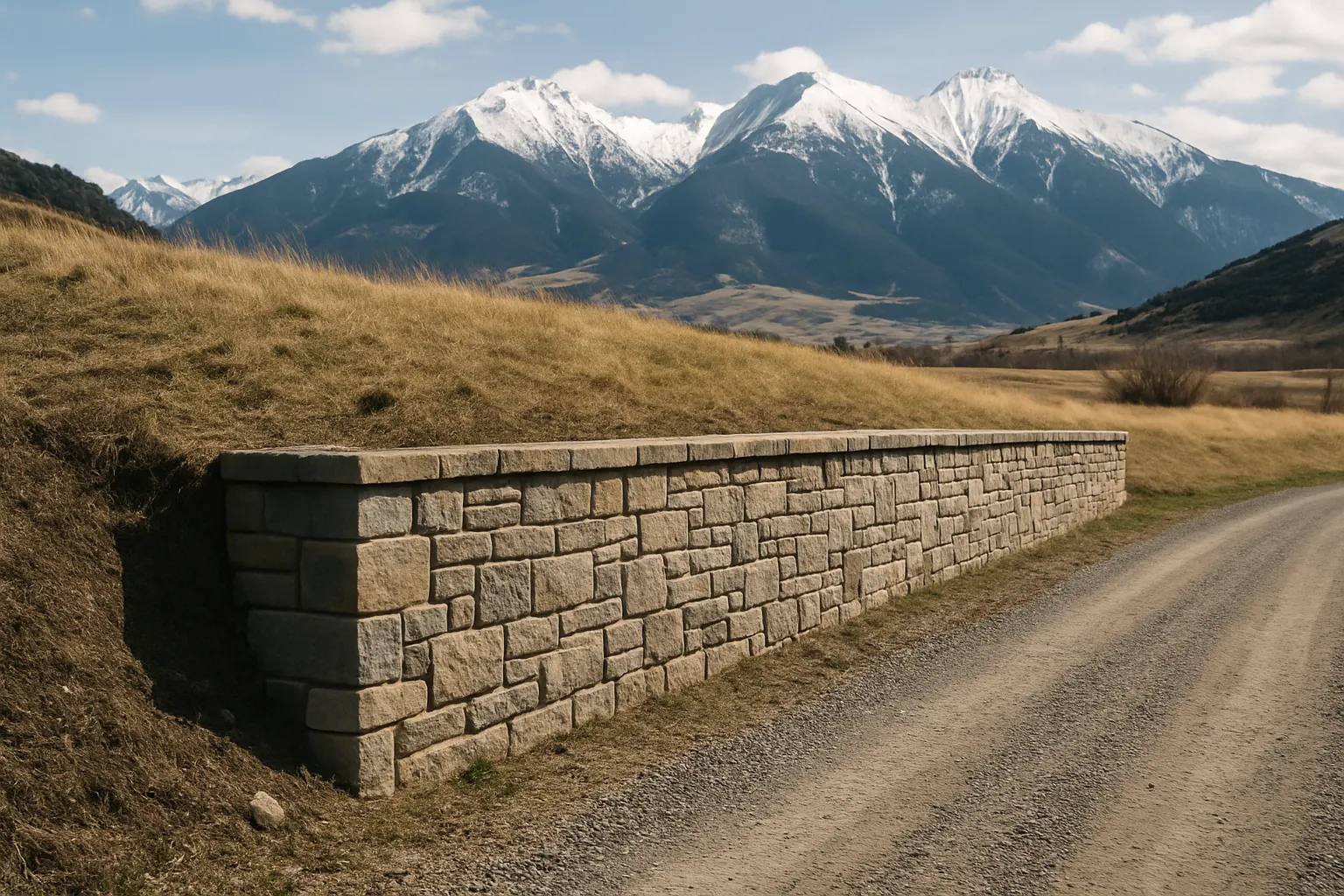
A boulder wall is a gravity wall. It holds a slope with mass and friction: large stones set on a compacted base, each course stepped back into the hill so the weight of the wall leans into the cut rather than away from it. No mortar, no concrete footing, no mechanical connection between stones. It works because rock is heavy and because it was set correctly.
A built retaining wall — block, mortared stone, or a poured system — holds ground through structure: a footing set below frost, engineered backfill, and often reinforcement tying the wall back into the hillside. That structure buys height and load capacity stacked stone cannot reach, and it takes more work and more design to get there.
| Consideration | Boulder wall | Built retaining wall |
|---|---|---|
| Height range | Low to moderate, or stepped in terraces | Taller single spans |
| Footprint behind the face | Larger; the wall needs room to batter back | Tighter; better where space is short |
| Drainage | Drains between stones by nature | Must be designed in with rock, fabric, and an outlet |
| Look | Rugged, natural against mountain ground | Clean, defined, formal edge |
| Site access | Needs equipment reach for large stone | More labor, less dependent on big machine swing |
| Load above the wall | Yard, landscape, light grade | Driveway, structure, or surcharge loads |
Why Montana is hard on walls
Frost. Ground here freezes well below the surface. Anything that traps water behind a wall turns that water into a jack. Saturated backfill freezes, expands against the face, thaws, drains poorly, and does it again the next cycle. Freeze-thaw cycling, not one dramatic storm, is what moves most walls out of line.
Spring runoff. A wall cut into a hillside intercepts water that used to keep moving downhill. If you do not give that water a path, the wall becomes a dam. Our runoff window is short and intense, and a wall that looked fine all summer can bulge during a single melt. The same principles in our rural drainage guide apply here: route water around and through, never against.
Soils. Ground changes over short distances in Paradise Valley — river gravels one place, silt or heavy clay the next. Gravel drains and carries a base well. Clay swells when wet, holds water against the back of the wall, and loses bearing capacity at exactly the moment the wall needs it. That difference drives both base prep and drainage design.
Access and season. Boulders arrive by truck and get set with a machine. If equipment cannot reach the wall line, stone size has to come down, and that changes what the wall can hold. Wall work also needs unfrozen, workable ground, which puts it inside a short building season.
How the work goes, in order
- Read the slope: height to hold, what sits above the wall, and where water arrives from.
- Cut and bench the hillside back so there is room to build, not just room to stack.
- Excavate a base trench into undisturbed ground and compact clean crushed rock in it.
- Build drainage first — washed rock behind the face, fabric to keep fines out of it, and a daylighted outlet that actually runs downhill.
- Set the wall, stepping each course back and breaking joints, with the largest and flattest stone at the bottom.
- Backfill in lifts and shape the grade above so surface water sheds away from the top of the wall instead of over it.
Because we handle the excavation and grading as well as the stonework, the cut, the drainage, and the wall are one job with one crew instead of three.
Signs an existing wall is in trouble
Look at the face from the end, sighting down its length. A wall that has gone wavy, tipped forward at the top, or opened gaps between courses is telling you water is working behind it. Soil or fines washing out through the face means the drainage rock has plugged with sediment. Cracks in the ground above the wall, a sinking spot behind it, or a wet seep at the base after the ground has otherwise dried all point the same direction. Caught early, a section can often be pulled and reset with proper drainage. Left alone, the failure spreads along the wall and the fix becomes a rebuild.
Common mistakes
Stacking a wall on topsoil rather than a cut base. Building the face plumb instead of battered back. Backfilling with the native clay that came out of the cut. Using stone too small for the height. And the one that catches the most people: solving the wall while ignoring what feeds it — roof runoff, a driveway crown, or a culvert outlet aimed straight at the backfill. Pair the wall with real erosion control above it and it stays put.
What drives scope
Height and length set the baseline. Beyond that: how much cut the slope needs, whether the soil requires over-excavation and imported base, how far equipment has to reach, whether stone is native or hauled in, and how complicated the drainage outlet is. A low boulder wall on gravelly ground with a flat staging area is a different job than a tall wall on a steep, tight, clay-heavy site.
Planning a wall anywhere in Paradise Valley? Request a free estimate or call (406) 623-9075 and we will look at the slope before recommending anything.
Have a project in mind?
EZ Road Repair handles road building, excavation, drainage, masonry, and snow work across Paradise Valley and Southwestern Montana.