
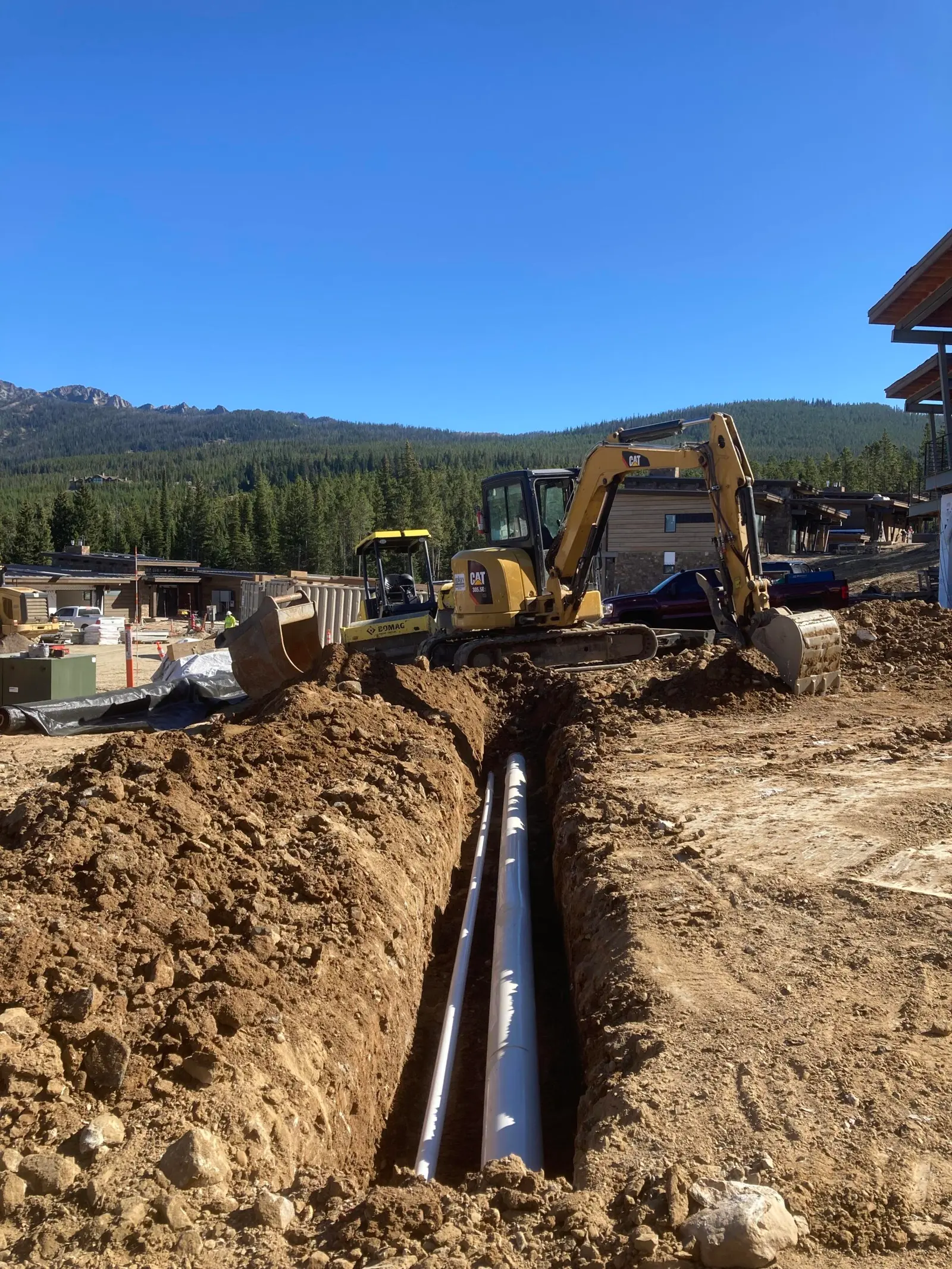
Water goes somewhere whether you plan for it or not. A ditch is how you decide where.
Ditch Digging & Swale Construction in Paradise Valley, Montana
EZ Road Repair cuts ditches and builds swales across Emigrant, Livingston, Pray, Gardiner, and Chico: roadside ditches that keep runoff off the driving surface, interceptor ditches that catch hillside water before it reaches a building, and wide swales that move water across ground without tearing it up. Open channel is the cheapest drainage that works — but only when grade, shape, and outlet are right. Get one wrong and the ditch becomes the next erosion problem.
When this matters
- A road or driveway that goes soft or washes because water has no ditch
- Spring runoff coming off a slope straight at a house, shop, or pad
- Pasture or yard that gullies, ruts, or stays wet into July
- Old ditches silted in, slumped, or grown shut with grass and willow
- Irrigation or stock-water ditches needing re-cutting or rerouting
Ditch or swale — they do different jobs
A ditch is a defined channel with a bottom and side slopes, cut to carry water somewhere on purpose. Along a road the flowline has to sit below the gravel section, usually a foot or more under the subgrade, so the base can drain into it. A ditch level with or above the road base does nothing: the gravel stays saturated and pumps out under the first loaded truck of spring, no matter how good the road mix on top is.
A swale is wide, shallow, and flat-sided, built to slow water and spread it rather than concentrate it, with side slopes laid back far enough to mow, drive across, and plow without dropping a wheel. Water that has to travel wants a ditch; water that has to slow down and soak in wants a swale.
Grade decides everything
Ditches fail in two directions. Too flat — under about a half percent — and the water loses the energy to move sediment, so the channel silts in and grass takes it over within a few seasons. Too steep and it runs fast enough to pick material out of the ditch itself, and you’ve built a new washout that eats headward up the run. Roughly one to two percent is where most roadside ditches want to live.
The valley doesn’t always offer that. On steep driveway cuts above Pray or in the side drainages toward Tom Miner, the ground falls faster than a bare channel can take, so the ditch gets armored: seeding on the mild sections, riprap on the steep ones, check dams to break one long fall into several short ones, and an apron at the outlet so water sheds its energy before it hits bare dirt — the same erosion control thinking the slope above needs. Every ditch also needs a real outlet: one ending in a low spot is a pond, one ending at the property line is somebody else’s problem.
What Montana adds
Freeze-thaw is why a ditch that handled August thunderstorms fails in March. It fills with drifted snow and ice, meltwater runs on top of the frozen bottom instead of in it, and at the first restriction — culvert inlet, approach, plow berm — it jumps the bank and takes the road. Ditches here get the depth to work half full of ice, and inlets get cleared before the melt. Winter shapes the cross-section too: a ditch tight to the shoulder with steep sides leaves nowhere for the plow berm, so it ends up in the channel. Laid-back slopes keep snow removal and drainage from fighting each other.
Then there’s irrigation. Water here is spoken for, and channel already crossing your ground may carry a decreed right, a head gate, or other users. We work around existing irrigation ditches rather than through them, and if one has to be crossed or moved, that’s a conversation with the ditch owner first.
Where this goes wrong
- Blade spoil windrowed along the shoulder. A berm between road and ditch traps water on the driving surface.
- Culvert invert set above the ditch flowline. Water ponds behind the pipe, silt drops out, and it plugs. The pipe has to match the channel.
- Side slopes cut too steep. Near-vertical banks slough, won’t hold seed, and can’t be mowed or plowed around.
- Bare dirt left over winter. A fresh cut with no seed or straw loses its shape in the first runoff. Vegetation is structure here, not decoration.
How we approach it
We start by walking the water — where it comes from, how much shows up in a real melt or a hard cell off the Absarokas, and where it can end up. Then we check grade, since the available fall decides whether the answer is a ditch or a swale. From there we cut the channel to shape, keep the flowline below the road section where it serves a road, and set culverts at matched inverts where water crosses an approach. Steep runs get armored, mild runs get seeded. We tie the channel into the surrounding grading so the ground sheds toward it, and where the trouble is subsurface we’ll say so and put in a French drain instead. Ditches and swales are one part of a whole drainage system; if runoff has already cut a road, spring runoff repair happens on the same trip.
Serving Paradise Valley & Southwestern Montana
Based in Emigrant, we cut and rebuild ditches throughout Paradise Valley — Livingston, Pray, Chico, Gardiner — and the ranch country around it, where moving water well is the difference between a good year and a muddy one.
Get a ditch or swale estimate
Call (406) 623-9075 or request a quote. Tell us where the water shows up and what it’s damaging, and we’ll walk the path it takes and put together a straight estimate.
EZ Road Repair and Excavation — locally owned, Montana tough.