
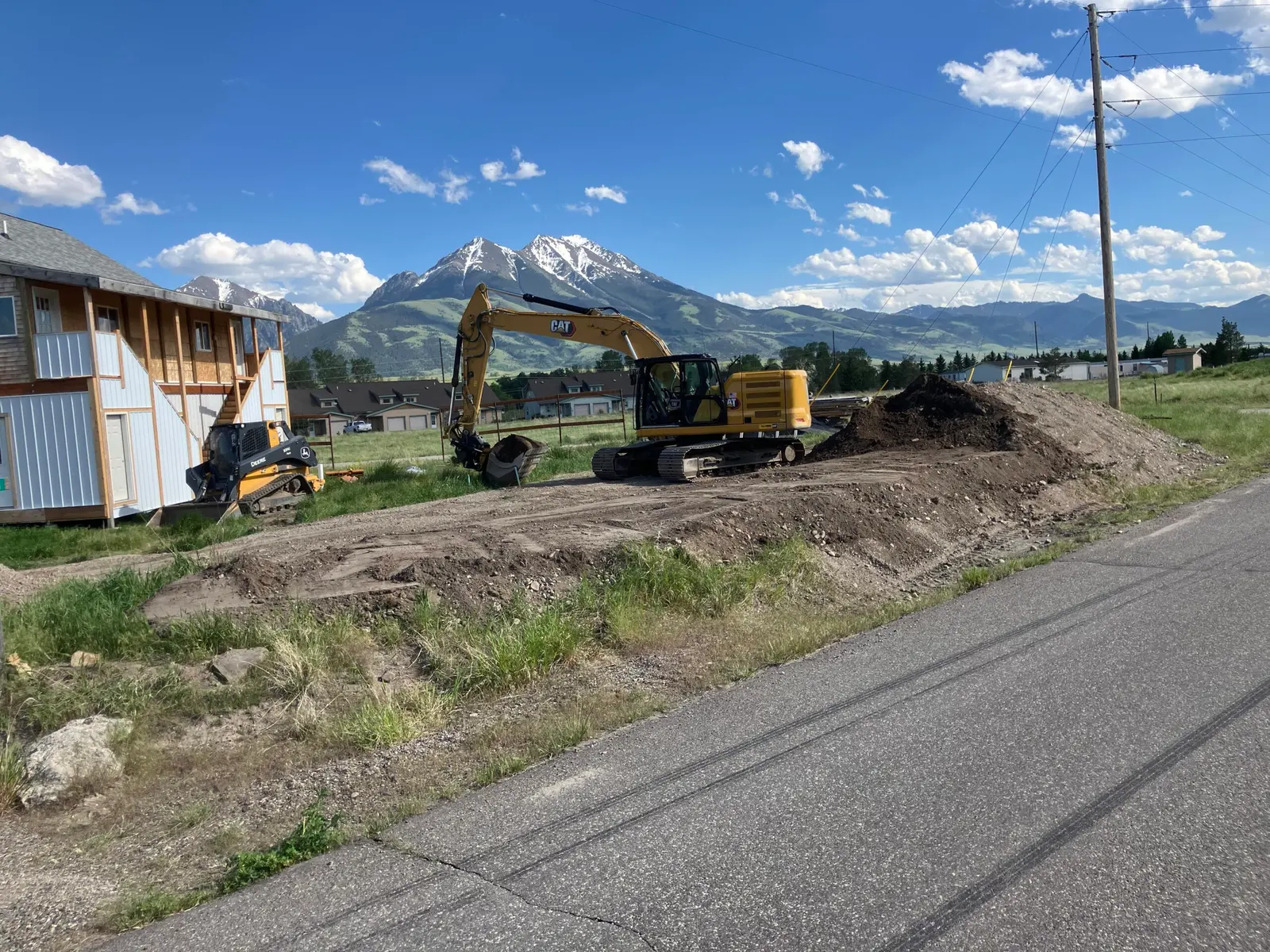
A concrete driveway is a rigid plate laid on Montana ground that moves. Everything about building one well comes down to that sentence.
Concrete Driveways in Paradise Valley, Montana
EZ Road Repair builds concrete driveways, aprons, approaches, and parking pads across Emigrant, Livingston, Pray, Chico, Gardiner, and the length of Paradise Valley. Concrete earns its place on steep pitches where loose rock migrates downhill every spring, on turning approaches, and at garage and shop entries. What it cannot do is flex. Gravel absorbs a little ground movement and keeps working; a slab either stays supported or it cracks and tips — which is why we treat concrete flatwork as an excavation and drainage job that ends with a pour. Still weighing surfaces? Our driveway construction options comparison lays them out, and plenty of properties here do best with a concrete apron up top and a road mix gravel run for the long stretch.
When this matters
- A pitch steep enough that gravel washes or spins out under winter traffic
- An apron or turnaround where delivery trucks and trailers load and pivot
- A garage, shop, or barn entry that needs a permanent surface at the door
- A slab that has heaved, cracked corner to corner, or dropped at one panel edge
- A new build where flatwork has to tie into finished grade around the foundation
What the slab is really sitting on
Uniform support matters more than raw concrete strength: a slab bridging a soft spot cracks over it every time, however thick it is. So the work starts below grade — strip topsoil and organics completely, since sod, roots, and black dirt hold water and keep consolidating for years, then dig to firm native ground and build back up in compacted lifts of well-graded crushed base rock. Thin lifts compacted properly beat one thick lift rolled a few times, which is the whole point of why compaction makes or breaks a driveway, pad, or road.
That base does two jobs: it spreads the load, and it gives water somewhere to go instead of sitting under the concrete. Freeze-thaw is behind nearly every failed slab we get called to look at. Water collects in or under the base, freezes, expands, lifts the panel, then thaws and leaves a void behind. Repeat that through a season and the best-finished slab in the county still comes apart. Clean drainable base, positive slope away from the structure, and somewhere for runoff to go are not extras on this job — they are the job.
Joints, thickness, and mix
Concrete cracks. Joints only decide where. Control joints get cut to roughly a quarter of the slab depth, spaced so panels stay near square — the standard rule of thumb puts joint spacing in feet at about two to three times the slab thickness in inches — and they get cut early, before the slab cracks on its own schedule. Isolation joints go anywhere the driveway meets something that moves independently: a foundation wall, a garage slab, a post base.
Thickness and reinforcement get matched to the load; a car pad and a slab a loaded gooseneck parks on are not the same slab. In this climate the mix should be air-entrained — microscopic voids that give freezing water somewhere to expand into — and the finish broomed for traction rather than troweled slick, because a glass-smooth slab on a Paradise Valley grade in January is a bad idea.
Where this goes wrong
- Poured on frozen or thawing ground. The slab settles as the ground gives up its ice. A cold-weather pour needs real protection or it needs to wait for spring.
- Poured over a trench line. A water or power trench backfilled loose becomes a settled strip under the concrete, and the slab cracks along it.
- Joints cut late, shallow, or not at all. The crack shows up anyway, wandering across the panel where nobody wanted it.
- De-icing salt, especially the first winter. Salt drives scaling — the surface flakes and pits. Sand or cinders do the traction job without attacking the concrete.
- Roof and hillside water dumped onto the slab. Runoff ponding at the edge undercuts the base and works under the panel.
- A hard lip against gravel. A slab edge standing proud of the surface beside it gives a plow blade something to catch. The transition gets feathered, and the edges marked before the first storm.
Base only, for your own flatwork crew
Not every job needs us for the pour. If you already have a concrete crew you trust, we will do the part they usually subcontract: excavation, compacted base, edge grading, and drainage, brought to the elevation their forms need.
How we approach it
We walk the site first: grade, access, where the water comes from, and what actually parks there. Old concrete gets broken out and hauled off along with any soft or organic material. Then the excavation goes to depth, base rock is built and compacted in lifts, and the pad is brought to a grade that sheds water rather than sitting dead flat. Drainage is set before anything is poured, with culverts or a graded ditch where runoff has to cross the driveway instead of run down it. Forms, thickness, reinforcement, and joint layout follow the slab’s size and loads, and the pour gets scheduled around the weather window instead of squeezed into the wrong one. If the job would be better served by another surface, we will say so — we build asphalt driveways too.
Serving Paradise Valley & Southwestern Montana
Based in Emigrant, we build concrete driveways, aprons, and pads throughout Paradise Valley — Livingston, Pray, Chico, Gardiner — and the surrounding communities.
Get a concrete driveway estimate
Call (406) 623-9075 or request a quote. Tell us the footprint, the grade, and what parks on it, and we will walk the site and put together a straight estimate.
EZ Road Repair and Excavation — locally owned, Montana tough.