
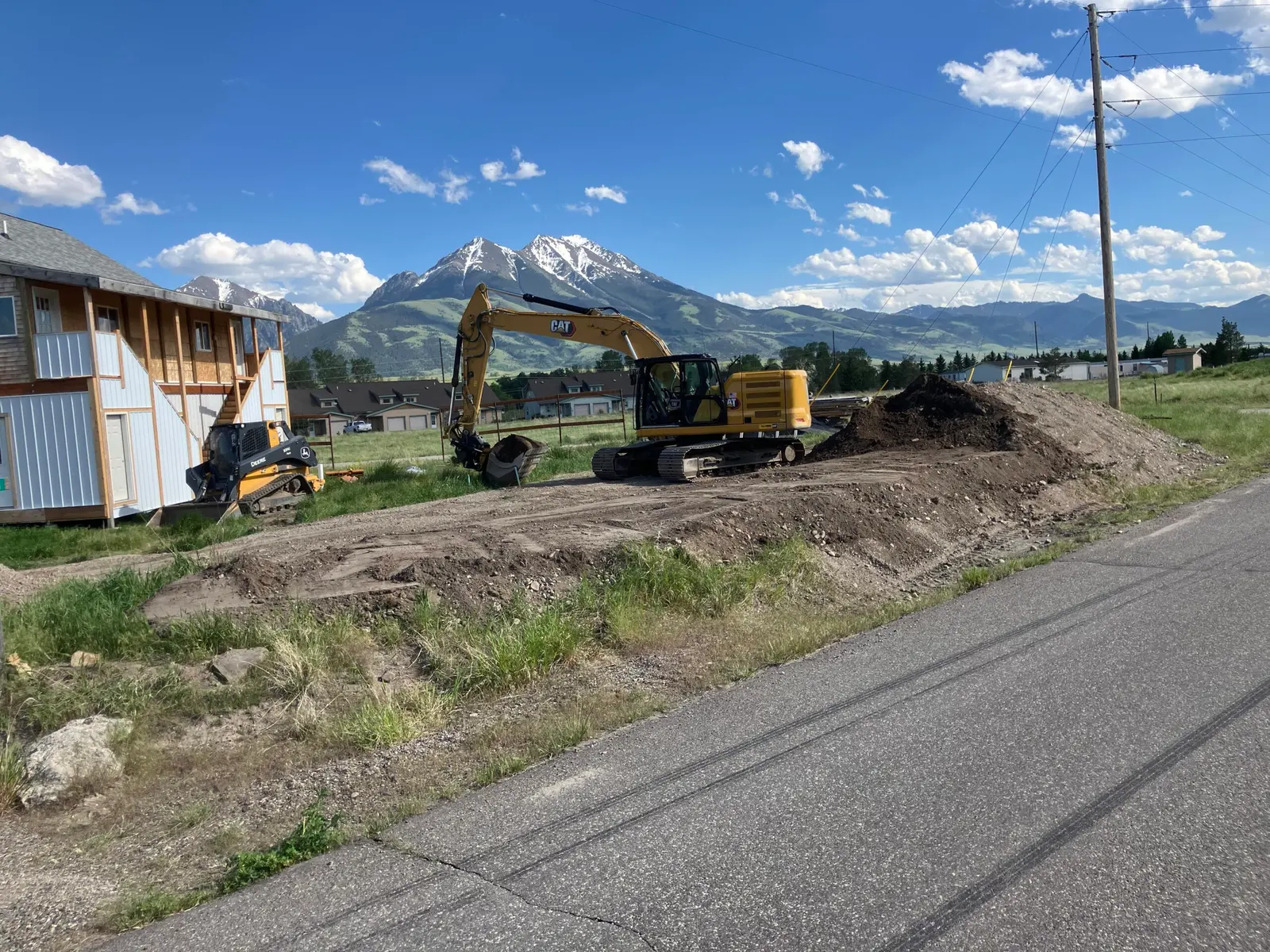
Asphalt is the wear layer. The driveway is everything underneath it.
Asphalt Driveways in Paradise Valley, Montana
EZ Road Repair builds asphalt driveways base-first out of Emigrant, working Livingston, Pray, Chico, Gardiner, and the length of Paradise Valley. Paving day is the last day of the job and the least interesting part of it. What decides whether that surface still looks like a driveway a decade out is the week before the mat went down — how far we dug, what went back in, how well it was compacted, and where the water goes. A driveway that cracks in its third winter almost never has an asphalt problem. It has a base problem wearing an asphalt hat.
When this matters
- You want a finished, paved approach to the house instead of gravel dust on the porch
- An existing driveway is cracking, potholing, or holding puddles after only a few years
- A gravel driveway has proven itself and you’re ready to pave ground that has already settled and drained
- You plow the drive every winter and want a surface that comes clean in one pass
- A parking apron, shop approach, or turnaround keeps rutting under daily traffic
Asphalt is only as good as the base under it
Asphalt is a flexible pavement — it doesn’t span anything. It spreads a wheel load through the mat into the base, and the base spreads it wider into the subgrade below. Every pound your truck puts on the surface lands on the dirt underneath. If that dirt is soft, wet, or full of organics, the pavement deflects further than it was built to and cracks from fatigue: hairlines first, then the interconnected pattern people call alligator cracking, then a hole.
So the real work happens below grade. We strip topsoil and anything organic out of the driveway prism, cut down to firm subgrade, and if it won’t hold, dig it out and replace it rather than pave over a soft spot and hope. Base goes in as crushed aggregate in lifts, each one compacted before the next is placed, because a thick layer dumped in one pass tightens on top and stays loose in the middle. Compaction is the whole ballgame on a driveway, pad, or road. Then the grade gets set: a crown or consistent cross slope, generally around two percent, so water leaves the surface instead of standing on it. Dead flat isn’t neutral. Dead flat is a puddle.
What Montana winters do to pavement
Freeze-thaw is the engine behind most of what we get called out to fix. Water works into a crack, freezes, expands, and levers that crack wider. The ice leaves, the water goes deeper, and the cycle runs again — and this valley crosses freezing far more often than the calendar suggests, with strong sun on a February afternoon and a hard freeze the same night. A crack you could have sealed in an afternoon becomes a pothole in a couple of seasons.
Spring is the other pressure. A saturated base in April is the weakest it will be all year, which is why road agencies post load restrictions during thaw. Run a loaded truck over a driveway while the ground underneath is still letting go and you’ll find every weak spot at once. Cold shrinks the mat too: straight cracks running across the drive are usually thermal contraction, not structural failure. They aren’t a problem by themselves — they’re an open door, and water is what walks through it.
Where this goes wrong
- Paving over the problem. An overlay on a failing driveway buys a season or two. The old cracks reflect straight back through the new mat, in the same places.
- Unsupported edges. Asphalt has almost no strength at an unconfined edge. If the shoulder washes away, tires and plow blades break it down and it ravels inward foot by foot. Edges need gravel shoulders built flush to the mat and sloped away.
- Late-season paving. Hot mix has to stay hot long enough to be compacted. Onto cold ground in a cold wind, the mat chills before density is rolled into it, and undercompacted asphalt fails early. We would rather tell you to wait than take the money in October.
- Water with nowhere to go. Pavement moves water beautifully and absorbs none of it. Without ditches, a culvert where runoff crosses, and drainage carrying it off the property, that water ends up under your edges.
- Skipping maintenance. Sealcoating and crack sealing are not upsells. Sealed cracks keep water out of the base; open ones invite it in.
- Paving a long rural drive that should be gravel. A quarter-mile drive means a quarter mile of base. Gravel costs less there, gets repaired with a blade instead of a saw cut, and tolerates ground that keeps settling. Asphalt earns its keep closer to the house.
How we approach it
We walk the drive first — length, grade, what’s there now, where water crosses, and how a plow will handle it. From there the sequence is consistent: strip and stockpile topsoil, cut the prism to firm subgrade, dig out and replace anything soft, build and compact base in lifts, then set crown and shoulders with grading and leveling so the surface sheds and the edges are supported. Drainage gets working before pavement goes down, not after. All of that is excavation work, so the same crew handles it start to finish. Still weighing surfaces? Start with driveway construction options, or read up on concrete driveways first.
Serving Paradise Valley & Southwestern Montana
Based in Emigrant, we build asphalt driveways throughout Paradise Valley — Livingston, Pray, Chico, Gardiner — and the surrounding communities.
Get an asphalt driveway estimate
Call (406) 623-9075 or request a quote. Tell us the length, the grade, and what’s on the ground today, and we’ll give you a straight answer — including whether your base is ready to pave or whether the money goes below the surface first.
EZ Road Repair and Excavation — locally owned, Montana tough.