
Reading what the ruts are telling you
Ruts and washboard look identical whether your road has simply worn down or its base has quietly failed underneath. The difference is not visible in a photo — it shows up in how the road behaves after it is fixed. A road with a sound base firms up under a grader and stays firm for a season. A road with a failed base looks perfect for a week and then rebuilds the same ruts in the same places, because nothing under the surface changed.
That single observation is the most reliable test a property owner has. If you have had a stretch graded twice in one season and it is rough again, you do not have a grading problem. You have a base and drainage problem that grading keeps covering up.
What actually fails underneath
A gravel road is three things stacked: the subgrade (native ground), a compacted base of angular rock, and a running surface of road mix that binds and sheds water. It works as long as those layers stay separate and stay dry.
Water is what unstacks them. Around Paradise Valley the sequence is predictable. Fall rain and snowmelt soak into a road that has lost its crown. Frost drives down several feet through the winter and lifts the saturated sections unevenly. Then March and April arrive: the surface thaws while the ground below is still frozen, so meltwater has nowhere to drain and sits in the base. That is the weakest a road will ever be, and it is exactly when loaded trucks and equipment are on it. Under a wheel, saturated fines pump upward and rock presses downward until the base and the subgrade become one muddy layer that will not compact. Once that mixing happens, no amount of blade work reverses it.
Signs you can check yourself
Walk the road after a wet stretch and look for these:
| What you see | What it usually means |
|---|---|
| Washboard on grades and corners, road firm underfoot | Surface wear — a regrade |
| Shallow ruts that hold shape for months | Surface wear — a regrade |
| Ruts back within days of grading | Base failure |
| Mud pushing up through clean rock | Base and subgrade have mixed |
| Ponding in the wheel tracks, no ditch outlet | Drainage failure feeding base failure |
| Ground flexing or springing under a truck tire | Saturated subgrade |
| Edges sloughing, road narrowing over time | Lost crown and lost shoulder support |
The flex test is the honest one. Drive slowly past a soft spot with someone watching from the side. If the ground beside the tire visibly moves, the base is not carrying load.
How the two jobs differ in practice
A regrade is reshaping. The blade cuts the high material, refills the ruts with it, restores a crown of roughly a quarter to a half inch of fall per foot from centerline to shoulder, and cleans the edges so water can leave. Fresh material and compaction go on top where the surface has thinned. Done at the right moisture, it lasts. Done to dry, dusty material, it feathers loose rock that the first storm moves.
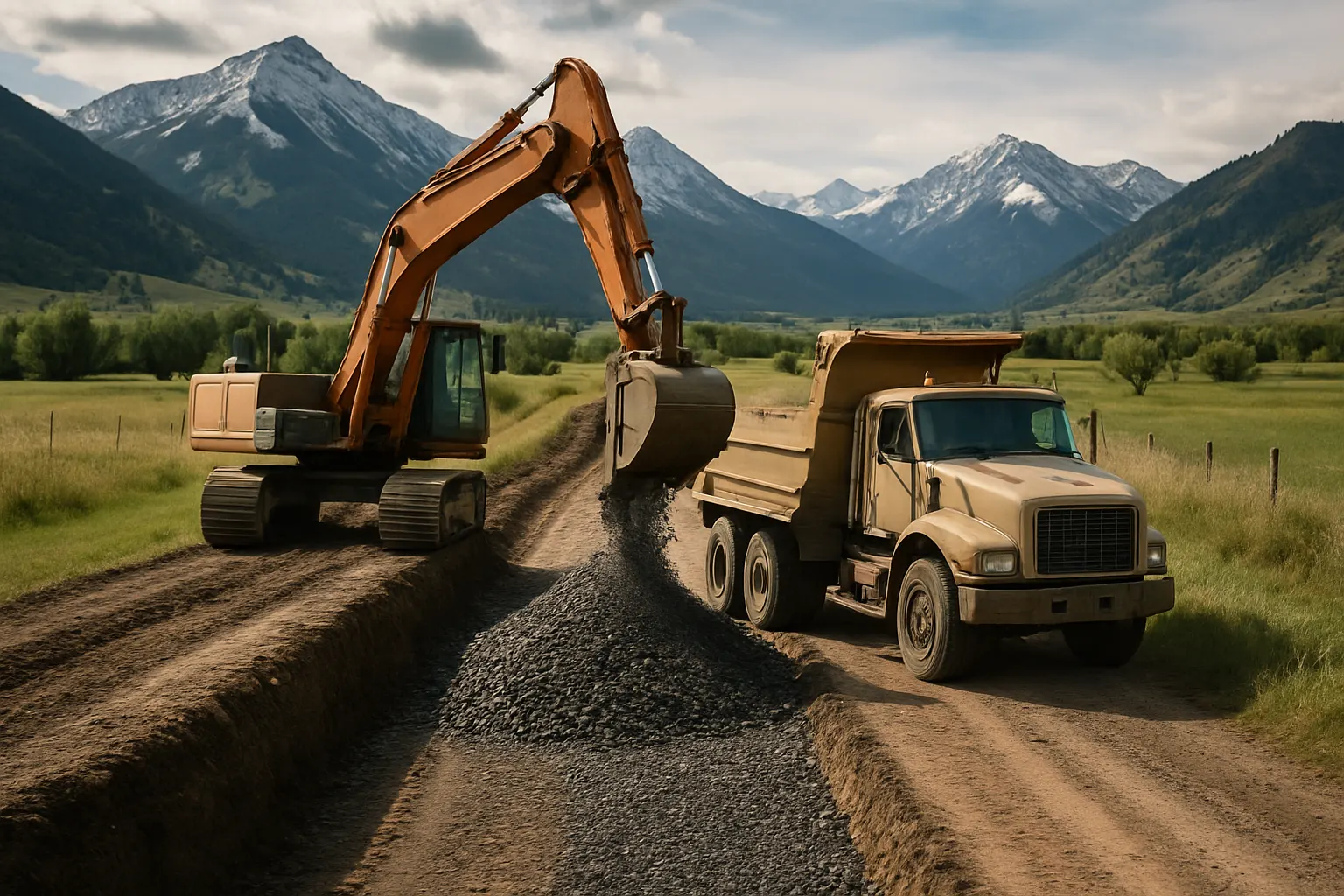
A rebuild goes in order, and drainage is first. Ditches get reopened, culverts get checked for grade and crushing, and low spots get an outlet. Then the failed section is excavated to competent ground, fabric goes down where the subgrade is soft, and base rock is placed and compacted in lifts rather than one deep dump. Compaction in thin lifts is not a formality — it is the difference between a section that holds for years and one that ruts by August. Surface material and crown go on last.
Mistakes that cost the most
Grading a failing section repeatedly is the common one. Each pass buries good rock into mud and thins what is left. Second is blading in the wrong direction on a crowned road so material walks to the center or over the edge. Third is skipping the ditch. Plenty of roads here would never have failed if the ditches had been pulled and the culverts kept clear and flowing before spring. Fourth is hauling heavy loads across a road during thaw, which can undo a good base in a single day.
What drives scope and timing
Length of the failed section, depth to competent ground, how far material has to be hauled, whether the road is wide enough for equipment to work without tearing up what is sound, and how much ditch and culvert work has to happen first. Steep grades and sidehill cuts add work because they need drainage crossings and controlled runoff. Timing matters too: rebuild work goes best once the ground has dried out in early summer, and finish work should land before freeze-up.
Not sure which road you have around Paradise Valley? We look at how it behaves after grading, whether water has an outlet, and what is under the surface, then say plainly whether a regrade will hold — including when it will. Background on materials and construction is in our Montana gravel driveway and private road guide. Request a free estimate or call (406) 623-9075.
Have a project in mind?
EZ Road Repair handles road building, excavation, drainage, masonry, and snow work across Paradise Valley and Southwestern Montana.