
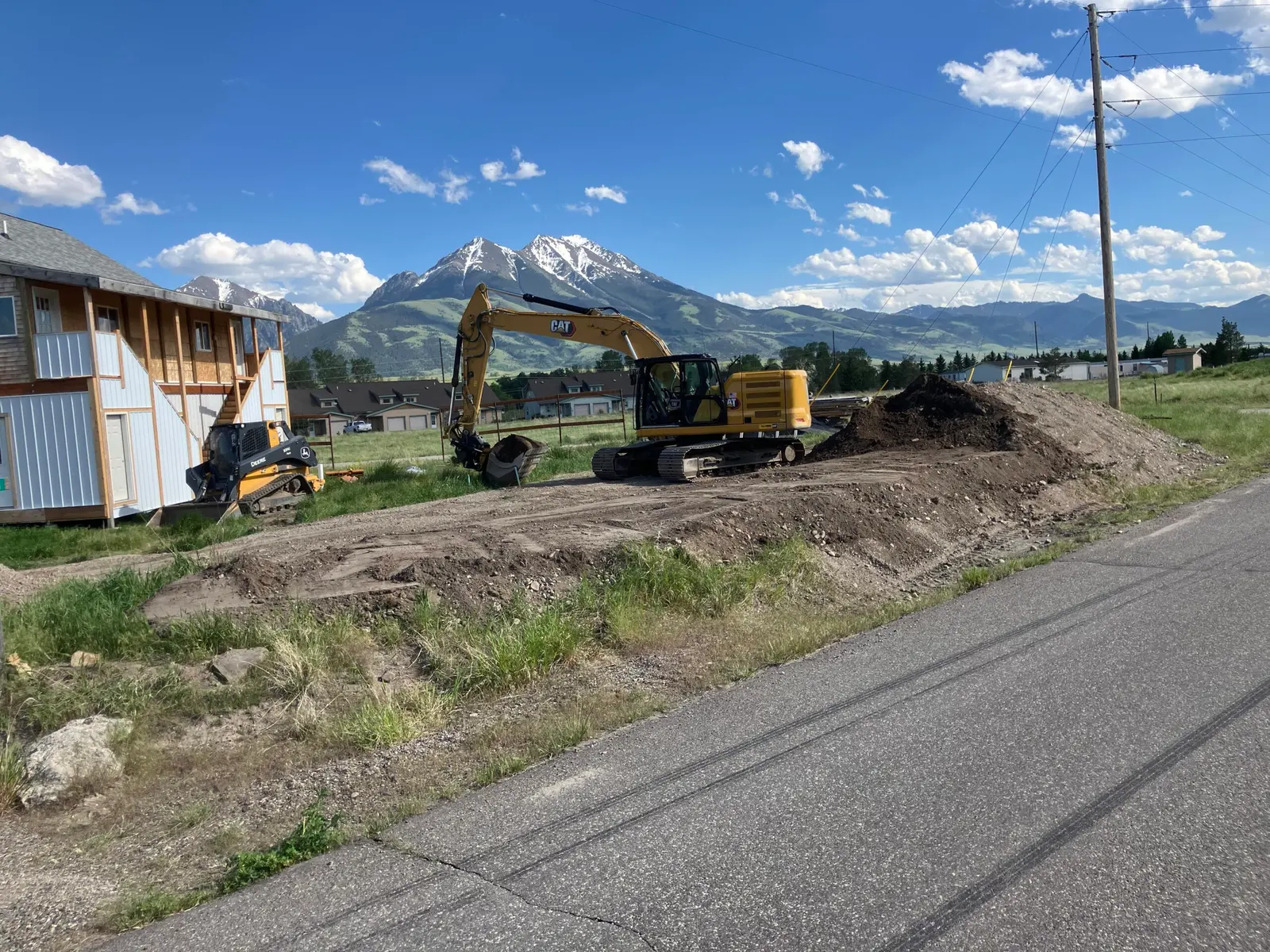
Some roads don’t fit a standard bid — too steep, too rocky, too far back in, or carrying loads a driveway was never built for.
Specialty Road Services in Paradise Valley, Montana
EZ Road Repair is based in Emigrant, and a good share of our work is the road nobody else wants to bid: the switchback climb to a cabin site above Pray, the logging or equipment road up a timbered draw, the access into an inholding where the last two miles are the whole problem. Standard road building covers the route across the hayfield; this page covers the one that gains a few hundred feet in a half mile and still has to carry a concrete truck in June — plus the heavy-use surfaces treated like roads: yards, turnarounds, approaches, and gravel parking lots.
When this matters
- The route to your building site is steep enough that a loaded truck spins on it
- There is no straight way up the slope, so the road needs switchbacks
- You bought an inholding or a back parcel and the access is a two-track that washes out every spring
- Logging or a construction phase needs a road heavy equipment can actually use
- The road has to cross a sidehill, a draw, or a seasonal drainage
- A yard, lot, or turnaround has to carry loaded trucks and trailers, not cars
What steep ground does to a road
Grade is the first constraint, and the question isn’t whether a pickup makes it in August — it’s whether a loaded gravel truck or a plow truck can. Sustained grades much past 8 to 10 percent start eating traction, and beyond that loose surfacing migrates downhill under tires; the gravel you paid for ends up in a berm at the bottom. Where the ground forces a steeper pitch, it gets kept short rather than run as one long uniform climb.
Water is the second constraint, and on grade it does the real damage: a long uninterrupted pitch lets runoff gather speed in the wheel tracks until it cuts a gully instead of crossing the road. On an equipment road the answer is water bars — a trench and berm set at a skew across the road, angled downhill, spaced tighter as grade steepens, with the outlet armored onto stable ground so it doesn’t start a new gully off the shoulder. On a road driven and plowed year-round a plow blade destroys water bars, so broad-based dips — long, drivable grade reversals — do the same job. Between relief points the surface is crowned or outsloped a couple of percent.
Third is how the bench is built. On a sidehill the cheap way is cut-and-fill: push half the width out onto the downhill side. Fill laid on a steep slope over duff and topsoil, with nothing keying it in, is exactly what slumps two springs later and takes the outside wheel track with it. Full-bench construction — cutting the whole width into the hill and hauling the spoil to a stable place — costs more and doesn’t. Where fill is used, the slope gets stripped and benched first, and it goes in compacted lifts rather than one push.
Switchbacks are their own problem. The turn has to fit the longest vehicle that will ever use it — a lowboy or log trailer off-tracks well inside the front wheels — and it should be the flattest part of the climb, since a truck that’s turning has less traction left to spend on grade. Each corner gets a wide, nearly level platform benched into the slope, with the elevation picked up on the straights between.
Where this goes wrong
- Following the old two-track. The existing route went where it was easiest to walk, not where a road can be drained. Sometimes the right alignment is two hundred feet over.
- Unkeyed fill on a steep slope. It holds through the first summer and lets go during runoff; rebuilding costs more than benching it right would have.
- Building for one season. A road cut on frozen ground for winter logging can be unusable in mud season; what it carries, and when, changes how it gets built.
- No turnaround and no pullouts. If that road is the only way in for a fire truck or an ambulance, room to turn and pass isn’t an extra.
- Thin gravel over oversized rock. Shot rock telegraphs through a skimpy surface course; rocky subgrade needs a real transition layer, not a dusting of road mix.
How we approach it
We walk the whole route first — grade, sidehill, soils, rock, springs, and where the water goes in April, not August. Then we set an alignment that can be drained, clear only the width the road needs with land clearing, and build the bench, keying and compacting any fill in lifts. Crossings get sized to the drainage they carry — culvert installation, or a bridge on a real channel. Water relief goes in as the road is built, and cut and fill slopes get erosion control — riprap, seeding, armored outlets — before runoff finds them. Surfacing, turnarounds, and pullouts come last, sized to the equipment that will use them, and on ranch or shared-road work we stay on for road maintenance.
Two permits are the owner’s process, not ours: an approach onto a county road or state highway goes through the road department or MDT, and work in a live stream goes through the 310 process with the local conservation district. You or your engineer hold the application; we build to the approved design and coordinate with whoever draws it.
Serving Paradise Valley & Southwestern Montana
Based in Emigrant, we take on steep, remote, and heavy-use road work throughout Paradise Valley — Livingston, Pray, Chico, Gardiner — and out toward Bozeman and Big Timber.
Get a specialty road estimate
Call (406) 623-9075 or request a quote. Tell us where the road goes, what has to drive it, and what the ground looks like now, and we’ll walk it with you and put together a straight estimate.
EZ Road Repair and Excavation — locally owned, Montana tough.